The Quadratus Lumborum can cause some real grief through your back, buttock, hip, and groin but with the right management, exercises and self-treatment, you can be pain free – long term.
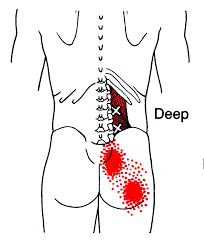
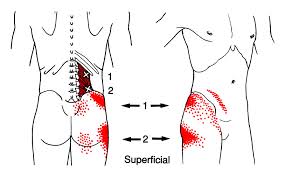
You can see the pain referral patterns below for the deep (closer to the spine) and superficial fibers of the QL muscle.
Referral from the quadratus lumborum can vary a lot between people due to this varied referral pattern.
In some, it can be a literal pain in the butt and others it is the side of the back, hip or the groin.
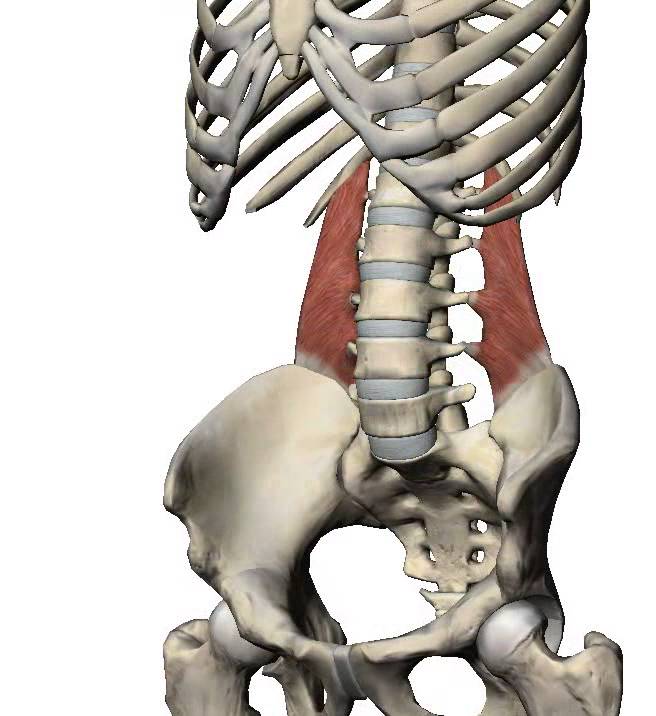
Quick Anatomy
You can easily see from the video below that as the quadratus lumborum tightens up, it can pull at your bottom ribs, vertebrae or pelvis.
If this happens one side more than the other, it can lead to some real asymmetry and not just cause back pain but a whole raft of other things.
How Can a Tight Quadratus Lumborum Effect You?
Apart from being painful, tight QL can also increase the load on quite a few other structures.
Often when one side tightens up it can lift that side of your pelvis a little making you feel out of place or out of alignment (even though your back can’t go out of place,1).
It can also pull at your ribs, tilting you to the side, limiting your reaching and restricting your breathing.
Last but not least if the QL is tight on both sides, you get more compression on your spine. Here is a post that talks about not being able to get off chair or floor.
The QL can also:
Cause a sharp stabbing pain in the low back
Cause pain and limitation when trying to turn in bed or stand from sitting
Make it look like you have a leg shorter than the other by holding one side of your pelvis higher
Contribute to a lot of other issues such as patellofemoral pain, trochanteric bursitis and scoliosis due to asymmetrical tension
Why Does the QL Get So Angry? The Real Causes
Before we get into fixing it, it’s worth understanding why the QL gets into trouble in the first place — because for most people, the cause is hiding in plain sight in their everyday routine.
Prolonged Sitting
This is the biggest one.
When you sit for extended periods — at a desk, in a car, on a sofa — your QL is held in a shortened, compressed position for hours at a time.
Over days and weeks, it adapts to that shortened state and starts to resist being lengthened again.
Add to that the fact that sitting also switches off your glutes — the muscles that should be sharing the load with your QL — and you end up with a muscle that’s both tight and overworked.
If you sit for most of your working day, your QL knows about it.
Always Carrying on One Side
Think about how you carry things — your bag, your groceries, your child.
Most of us have a dominant side and use it for almost everything without thinking.
Carrying weight consistently on one side forces the QL on the opposite side to work constantly to keep you upright.
Over time that creates an imbalance where one QL is chronically overloaded while the other is underused.
This is one of the most common patterns we see — and one of the easiest to change once you’re aware of it.
Sleeping Position
Sleeping on your side with your top knee dropping forward — which most side sleepers naturally do — creates a rotational strain through the lower back that the QL has to resist all night.
If you wake up with stiffness or pain in the lower back or hip that eases as you move around during the morning, your sleep position is likely contributing.
A pillow between your knees when sleeping on your side can make a surprising difference almost immediately.
Leg Length Differences
Even a small difference in leg length — real or functional — can create a constant tilt in the pelvis that the QL has to compensate for.
A functional leg length difference is often caused by the QL itself being tighter on one side, which lifts that side of the pelvis slightly.
It can look like one leg is shorter than the other when it’s actually just the muscle pulling the pelvis up.
This is why treating the QL often makes people feel like they’ve been realigned — the pelvis drops back to level as the muscle releases.
The Wallet and Back Pocket Problem
This one catches people off guard.
Sitting on a wallet, phone, or anything in your back pocket for hours at a time creates a tilt in your pelvis and an uneven load through your lower back.
It sounds trivial but over the course of a working week it adds up significantly.
Move everything out of your back pockets before you sit down — it’s a genuinely easy win.
Stress, Tension and Your QL — The Connection Nobody Talks About
This is one of the less obvious but genuinely important contributors to QL pain, and it’s worth understanding because it explains why some people do everything right — the exercises, the heat, the releases — and still find their QL keeps coming back.
The QL is part of your body’s bracing response to stress.
When you’re under pressure — work deadlines, difficult situations, sustained anxiety — your nervous system activates a low-level muscular bracing pattern throughout the body, and the lower back and hip muscles are heavily involved.
Your body is preparing to fight or flee, even when there’s nowhere to go and nothing to fight. The QL tenses up as part of that response and if the stress is chronic and ongoing, the tension becomes chronic too.
This doesn’t mean your pain is in your head — it absolutely isn’t.
The muscle tension is completely real and completely physical.
But it does mean that if you’re going through a stressful period at work or in life and your QL keeps flaring up despite doing your exercises, that’s not a coincidence.
It’s your nervous system expressing itself through your body.
The practical implication is that recovery from stubborn QL pain often requires addressing the stress piece alongside the physical treatment.
This doesn’t have to be complicated — even ten minutes of diaphragmatic breathing, a short walk, or a basic mindfulness practice can meaningfully reduce the background muscle tension that keeps the QL wound up.
We’ll talk more about this in the lifestyle section below.
So How Do We Fix It?
In three steps:
Decreasing Tension: Ease the pain by decreasing tension by releasing the muscle (stretching often doesn’t help)
Regain Range of Motion: Get you back to normal by regaining full range of motion through your back and hips
Strengthening QL: And finally, treat the cause by improving strength of the QL so that it can handle everything you throw at it
1. Decreasing Tension to Ease pain
For this, we need the muscle to relax so the most important thing is reducing aggravating activities and applying heat.
Heat can be applied be a wheat bag, hot water bottle, heat rub or anything similar, it will make a big difference.
Of course make sure you don’t make it too hot or hurt yourself, by following the instructions.
Also, you can directly release the quadratus lumborum, which is far more specific than stretching.
Check out our past blog post to learn how to do a myofascial release for your Quadratus Lumborum with a simple massage ball or the QL Claw.
2. Regain Normal Range of Motion
We need to now get everything back to normal – not just the quadratus lumborum but the muscles that have changed because of the asymmetry that the QL caused.
The following stretch is perfect for this, just remember to relax into it and that it ISN’T, no pain-no gain.
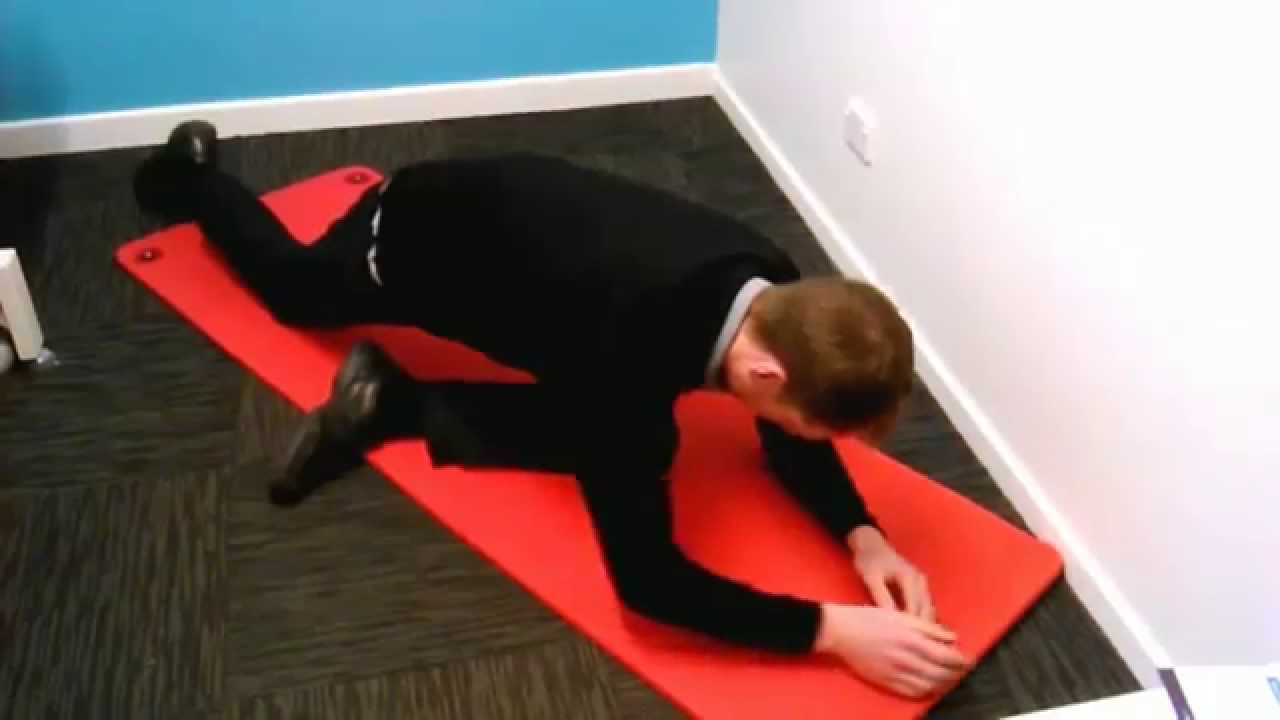
Gluteal Sretch: This will help even you out and regain hip range
3. Strengthen QL
Finally it is important to strengthen your quadratus lumborum stronger so that it can handle what you want to be able to do.
A stronger QL means less pain and you have more control and power, without having to avoid things constantly.
To load the QL, we need to load the side of your body.
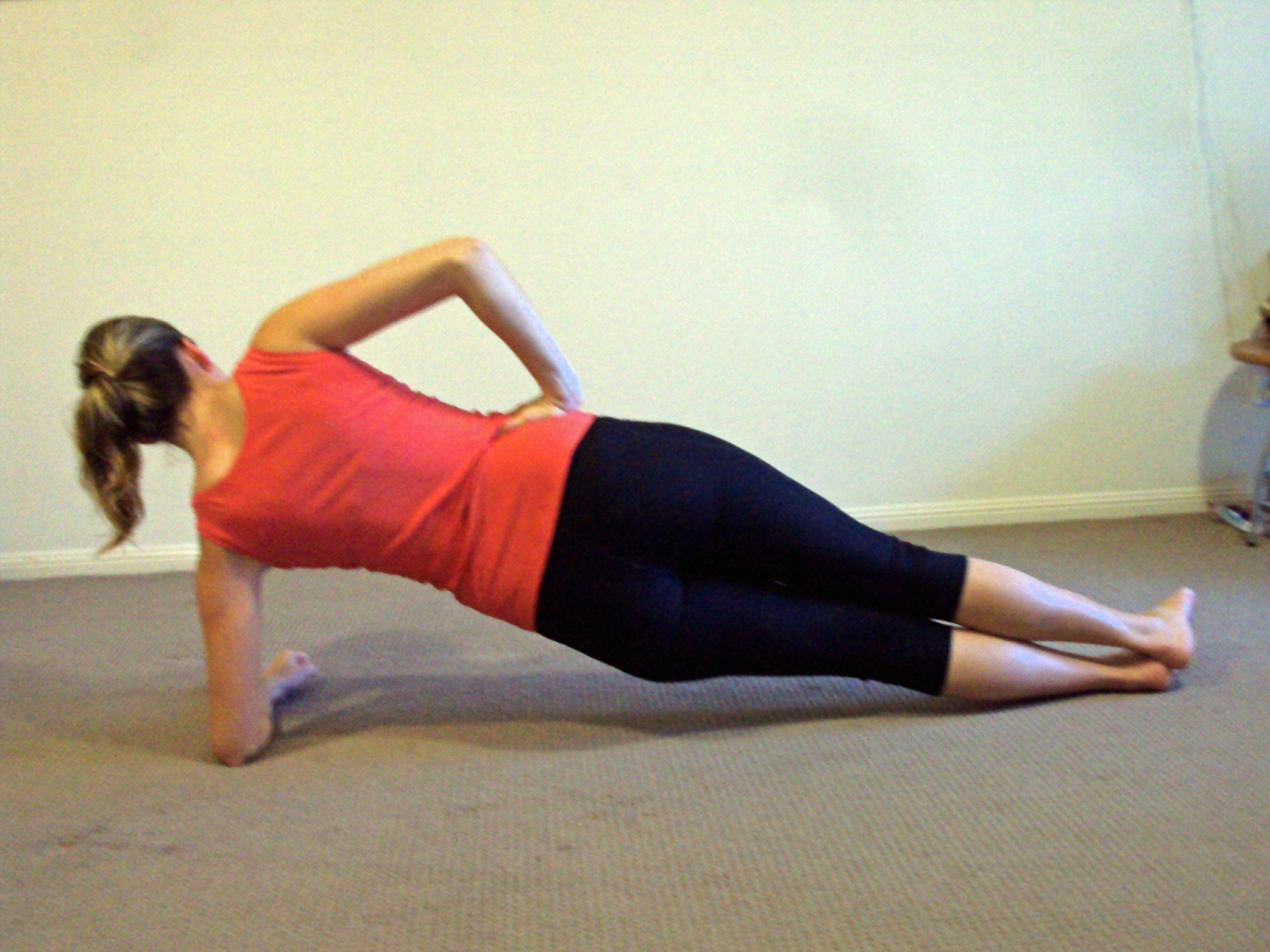
The best exercises to do this is the side planks and the one sided farmers carry:
Side plank Level 1
Hold for up to 1 minute. Once you can do that comfortably, progress to level 2 below.
Side plank Level 2:
In the side plank, raise your top leg up and down up to 10 times. Repeat 3 times each side.
One-sided farmers carry:
Hold onto a dumbbell, kettlebell or anything with a bit of weight to it in one hand and do some laps (e.g. 10 x 10m laps on each side).
Carrying a weight on one side makes the QL and obliques on the opposite side work hard to keep you upright.
Which Side Do I Hold the Weight?
This trips a lot of people up so let’s be crystal clear. If your RIGHT side is tight or painful, hold the weight in your LEFT hand.
Carrying the weight on your left makes the muscles on your RIGHT side — including the QL — work hard to keep you upright and stop you tilting over to the left. And vice versa.
So the rule is simple: weight goes in the opposite hand to the side you want to work. Do all your reps on one side, then switch the weight to the other hand and repeat on the other side. Try to stay upright!
If both sides feel tight — which is common — just alternate and do equal work on each side.
Feed Your Recovery: Nutrition That Supports the QL
What you eat plays a more direct role in muscle pain and recovery than most people realize.
You don’t need to overhaul your diet — but a few targeted nutritional changes can meaningfully speed up recovery and reduce the likelihood of the QL flaring up repeatedly.
Magnesium — The Most Relevant One for Muscle Pain
If there’s one nutritional factor most relevant to QL pain specifically, it’s magnesium.
Magnesium is essential for muscle relaxation — it’s the mineral that allows a contracted muscle to let go.
Low magnesium levels are directly linked to muscle cramps, chronic tightness, and poor recovery from muscular strain.
And magnesium deficiency is surprisingly common, particularly in people who drink a lot of coffee, alcohol, or who are under sustained stress — all of which deplete magnesium.
Good dietary sources include dark leafy greens, nuts and seeds, dark chocolate,legumes, and avocado.
If your QL seems to stay tight no matter what you do physically, low magnesium is worth looking into with your GP or through a simple supplement trial.
Anti-Inflammatory Eating for Chronic Back Pain
Chronic muscle and joint pain has an inflammatory component, and diet can either fan that flame or help dampen it.
The basics of anti-inflammatory eating aren’t complicated — more oily fish, olive oil, vegetables, berries and nuts; less processed food, refined sugar, and vegetable oils.
You don’t need a special diet or protocol. Just moving the needle in that general direction consistently makes a difference over time.
Oily fish like salmon, mackerel and sardines are particularly useful because omega-3 fatty acids have well-documented effects on reducing inflammatory pain.
Two or three servings a week is a realistic and meaningful target.
Hydration and Your Spinal Discs
The intervertebral discs that sit between your vertebrae are largely made of water and depend on good hydration to maintain their height and shock-absorbing capacity.
When you’re chronically dehydrated — even mildly — those discs compress slightly, which increases load on the surrounding muscles including the QL.
Staying well hydrated won’t fix a tight QL on its own, but it’s a small daily habit that supports everything else you’re doing.
Long-Term Prevention: Keeping the QL Happy Every Day
Once you’re out of pain, the goal shifts from fixing to maintaining.
These are the everyday habits that keep the QL from winding up again — and most of them take very little time once they’re routine.
Break Up Your Sitting — Every Hour
This is the single most impactful habit change for anyone with a desk job and a history of QL pain.
Set a timer for every 45-60 minutes and get up for two to three minutes — walk to the kitchen, do a couple of standing stretches, go up and down the stairs once.
You don’t need to exercise, you just need to move.
Extended unbroken sitting progressively loads the QL and switches off the glutes, and breaking that cycle regularly prevents the tension from building up in the first place.
Check Your Workstation Setup
Your chair height matters more than you’d think.
If your chair is too low your pelvis tilts backward and the QL has to work harder to support your spine.
If your screen is too low you’ll round forward which shifts load into the lower back.
A few basic adjustments — hips slightly higher than knees, screen at eye level, feet flat on the floor — can significantly reduce the daily load going through your QL.
It takes ten minutes to set up and pays off every single working day.
The Daily Maintenance Exercises
Once you’ve worked through the three-step program above and your pain has settled, don’t abandon the exercises completely.
Three times a week is enough to maintain the strength and mobility you’ve built.
The side plank and farmers carry are particularly worth keeping in your routine long term — they’re efficient, they target exactly the right muscles, and they take less than ten minutes combined.
Sleep Position
If you’re a side sleeper, place a pillow between your knees to keep your pelvis neutral through the night.
It removes the rotational strain on the QL and many people notice a significant reduction in morning stiffness within the first few days of doing this.
A reasonably firm mattress also helps — one that’s too soft allows your pelvis to sink and creates the same rotational loading.
Yoga and Mobility Work
Regular yoga — even a short beginner practice twice a week — specifically addresses the combination of hip flexibility, core stability, and spinal mobility that keeps the QL healthy long term.
You don’t need to be flexible to start.
Poses like child’s pose, pigeon pose, and supine twists directly target the QL and the surrounding musculature. (Yoga for back pain)
If yoga isn’t for you, even a ten minute daily stretching routine covering the hip flexors, glutes, and lateral back will make a meaningful difference.
When Should You See a Professional?
For the vast majority of people, QL pain responds well to the self-treatment approach in this post.
But there are some situations where it’s worth getting a professional assessment rather than continuing to self-treat.
See your GP or physiotherapist if:
The pain is severe or getting progressively worse rather than improving with rest and treatment.
You have pain that radiates down the leg — particularly below the knee — as this may indicate nerve involvement rather than pure muscle pain.
The pain is accompanied by bladder or bowel changes — this needs urgent medical attention.
You have significant pain at night that wakes you from sleep and isn’t related to movement or position.
You’ve been following this program consistently for four to six weeks without meaningful improvement.
You have a history of osteoporosis, cancer, or recent trauma — back pain in these contexts needs medical clearance first.
One important note: pain in the lower back and flank area can occasionally be referred from the kidneys rather than the musculature.
Kidney pain typically doesn’t change with movement or position, may be accompanied by fever or urinary symptoms, and often has a deeper, more constant quality than muscle pain.
If your pain fits that description, see your GP rather than treating it as a QL issue.
Summary:
And that’s it Folks. Adhere to these efforts and have a pain free and stronger body starting with your QL.
Heat
Release
Stretch
Strengthen
Work at that most days and notice the results. For a more detailed rehab plan, download our Complete Low Back Self-Rehab Guide to get great results.
On a side note, once you are feeling improved, don’t slack off on the exercises, they are great to do just to maintain yourself in great condition, even if it is just three times per week.
Frequently Asked Questions
How long does QL pain take to heal?
For an acute flare-up — where something triggered it recently — most people see significant improvement within two to four weeks of consistent treatment.
Chronic QL pain that has been building for months takes longer, typically six to twelve weeks of consistent work before it feels reliably better.
The key word is consistent.
Doing the exercises sporadically will get you sporadic results.
Can I exercise with QL pain?
Generally yes, with some modifications.
Activities that load the spine symmetrically and keep you moving — walking, swimming, gentle cycling — are usually fine and often helpful.
High-impact activities, heavy lifting, and anything that involves repeated twisting or lateral bending are best avoided during an acute flare.
As the pain settles, you can gradually return to your normal activities using pain as your guide.
If something makes it noticeably worse, back off and try again in a few days.
Is heat or ice better for QL pain?
Heat is almost always better for QL pain.
Unlike an acute injury where ice helps control immediate inflammation and swelling, QL pain is typically a muscle tension issue rather than an inflammatory one.
Heat relaxes the muscle, increases blood flow, and helps break the tension-pain cycle.
A wheat bag, hot water bottle, or heat patch applied to the lower back for fifteen to twenty minutes before your exercises is ideal.
Ice can occasionally help if the area feels acutely inflamed and hot to touch, but this is less common with QL pain than with other injuries.
Why does my QL keep coming back?
This is the most common frustration with QL pain and it almost always comes down to one of three things:
– The underlying cause hasn’t been addressed (usually prolonged sitting or a postural habit),
– The strengthening phase was skipped or cut short,
– Stress and tension are keeping the muscle wound up.
Releasing and stretching the QL treats the symptom.
Strengthening it and changing the habits that overload it treats the cause.
If you find yourself in a recurring cycle, work through the prevention habits in this post and be honest about which ones you’ve actually been doing consistently.
Can the QL cause hip pain and groin pain?
Yes — and this surprises a lot of people.
The QL’s referral pattern is quite varied, which is part of why it often goes un-diagnosed for a long time.
Deep QL fibers can refer pain into the buttock and hip, while more superficial fibers often refer into the groin and lower abdomen.
People sometimes go through investigations for hip pathology or even hernia before the QL gets identified as the source.
If you have hip or groin pain alongside lower back stiffness and it doesn’t have a clear injury cause, the QL is absolutely worth exploring.
Should I see a physio or a chiropractor for QL pain?
Both can be effective.
A physiotherapist will typically focus on hands-on treatment, exercise rehabilitation, and movement correction — which aligns well with the approach in this post.
A chiropractor may focus more on spinal manipulation and alignment.
The most important thing is finding a practitioner who takes a thorough history, explains what they’re finding, and gives you things to do at home rather than just treating you passively each session.
Passive treatment alone rarely produces lasting results with QL pain — active rehabilitation is what makes the difference long term.
Related
15 thoughts on “Quadratus Lumborum – Why it Hurts and How to fix it”
FH
Brilliant! Have been frantically googling my hip/back pain for days without joy. Practical succinct advice – what it is and how to fix it. Just what I needed
I cannot thank you enough for this…..I thought I had done something really serious…info is so straight forward , clear and helpful. Noirin, Scotland 🏴
Thank you for this information. You have described exactly what I am experiencing even down to the mild scoliosis. Will now work hard to gain some improvement.
Hi Beth, sorry, good question! Carrying a weight on your opposite side. Carrying something for example in your right arm makes your left lateral torso work to stop your upper body tilting off to the right.
Hi, sorry little confusing. So from your answer to Beth if I’m understanding this correctly, say my right side is tight, I should carry something in my right arm and then the left torso strengthens?? Thank you
You’re welcome! It’s great to do the Gluteal stretch 1-2 times daily (number 2) and then the strength exercises every 1-2 days depending on your recovery rate as it’s important to allow recovery and adaptation time when challenging out muscles. Possibly start off every second day to be safe.
If the right side QL is the one in pain/tight, does that mean the heavy dumbell should be carried on the right (tight) side, or would that not serve to pull that side down even further ?
If the right side Quadrarus Lumborum muscle (QL) is the one you are looking to strengthen, you would hold the weight in your opposite (left) hand. This is because the weight acts to create a pull to one side (the left) that the muscles on the otherwise (the right) have to oppose.
Hopefully that clarifies that and as an extra note, in most cases, it is best to make sure you work both sides – exercise one side and then the other to help balance out.
I’m a retired runner & this QL thing has popped up. I have a golden retriever. The QL thing is on the right side. When I walk her[she’s strong & weighs about 95 lbs…..she’ll pull a lot when walking. Can she be my weight?
My PT suggested that QL muscle may be the cause of my recent very painful lower back and buttock pain and reading your description describes my pain exactly especially the turning over in bed so I will do the suggested advice. Thank you


Brilliant! Have been frantically googling my hip/back pain for days without joy. Practical succinct advice – what it is and how to fix it. Just what I needed
I cannot thank you enough for this…..I thought I had done something really serious…info is so straight forward , clear and helpful. Noirin, Scotland 🏴
Thank you for this information. You have described exactly what I am experiencing even down to the mild scoliosis. Will now work hard to gain some improvement.
You are welcome Jeannette! now for the improvement
It’s not clear to me which side you should carry the weight on? Is it the side that’s tight? More explanation, please!
Hi Beth, sorry, good question! Carrying a weight on your opposite side. Carrying something for example in your right arm makes your left lateral torso work to stop your upper body tilting off to the right.
Hi, sorry little confusing. So from your answer to Beth if I’m understanding this correctly, say my right side is tight, I should carry something in my right arm and then the left torso strengthens?? Thank you
Hi Lil, do it on one side and then the other as it is best to strengthen both sides.
Hi, thank you so much for this article, i have been dealing with QL issues for 3 years. My question is how often to do the stretches and exercises?
You’re welcome! It’s great to do the Gluteal stretch 1-2 times daily (number 2) and then the strength exercises every 1-2 days depending on your recovery rate as it’s important to allow recovery and adaptation time when challenging out muscles. Possibly start off every second day to be safe.
I’d also like clarity here.
If the right side QL is the one in pain/tight, does that mean the heavy dumbell should be carried on the right (tight) side, or would that not serve to pull that side down even further ?
Hi Pierre
If the right side Quadrarus Lumborum muscle (QL) is the one you are looking to strengthen, you would hold the weight in your opposite (left) hand. This is because the weight acts to create a pull to one side (the left) that the muscles on the otherwise (the right) have to oppose.
Hopefully that clarifies that and as an extra note, in most cases, it is best to make sure you work both sides – exercise one side and then the other to help balance out.
Would these exercises be suitable for a muscle strain in the QL?
I’m a retired runner & this QL thing has popped up. I have a golden retriever. The QL thing is on the right side. When I walk her[she’s strong & weighs about 95 lbs…..she’ll pull a lot when walking. Can she be my weight?
My PT suggested that QL muscle may be the cause of my recent very painful lower back and buttock pain and reading your description describes my pain exactly especially the turning over in bed so I will do the suggested advice. Thank you