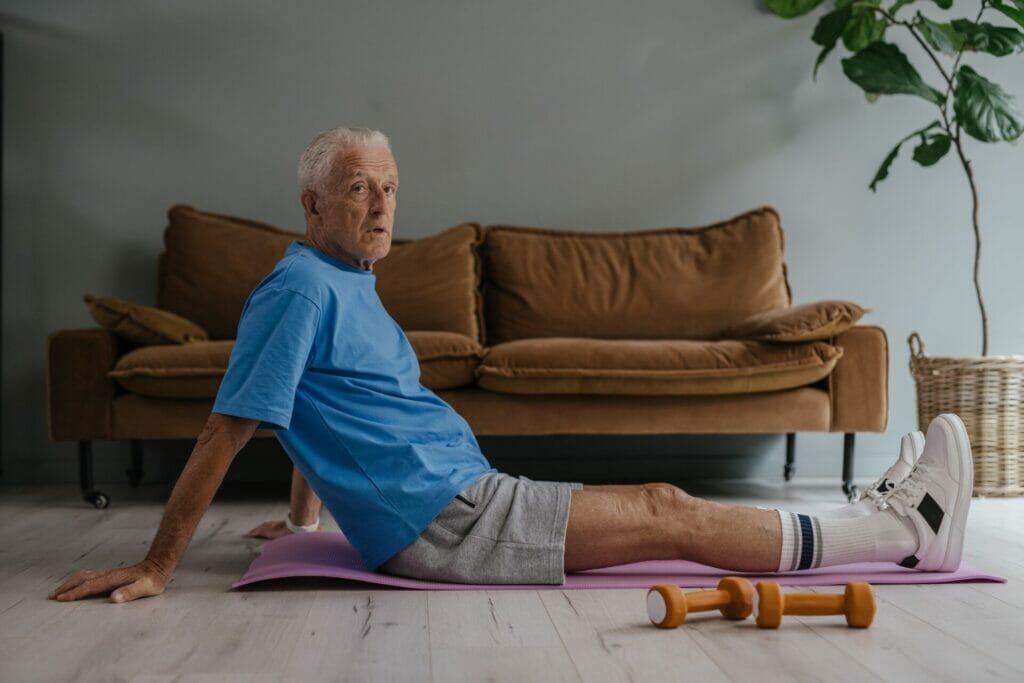
If you’ve noticed that getting up off the floor or out of a chair feels harder than it used to, you’re not imagining it — and it’s not just ‘age’.
There are some very specific things happening in your body that explain it, and the good news is that most of them are reversible with the right approach.
Muscle Loss (Sarcopenia)
From around the age of 35, we naturally start to lose muscle mass — a process called sarcopenia.
After 60, this can accelerate to losing up to 3% of muscle mass per year if you’re not actively working against it.
The muscles most affected are exactly the ones you need to get up off the floor: your quads (thighs), glutes, and core.
This isn’t inevitable though — the right exercises (which we’ll cover below) can stop this in its tracks and even reverse it.
Tight Hip Flexors from Sitting
Most of us spend a significant portion of the day sitting — whether at a desk, in a car, or on a sofa.
Over time, this shortens and tightens the hip flexors, the muscles at the front of your hip that are critical for the transition from floor to standing.
Tight hip flexors don’t just limit your movement — they also switch off your glutes, meaning your most powerful muscles essentially go to sleep. Check out this post for Glute Activation.
You end up fighting your own body when you try to get up.
Declining Balance and Coordination
Balance is something we rarely think about until it starts to go.
Our balance system relies on three things working together: our eyes, our inner ear, and the sensory receptors in our joints and muscles (called proprioceptors).
With age and reduced physical activity, the feedback from these receptors gets slower and less accurate (Quick Stability and Balance Test)
This is why getting up from low positions can feel uncertain or unstable — your brain isn’t getting the sharp, fast signals it used to.
Again, this is trainable, which is why one of the exercises below focuses specifically on this.
Understanding why this happens is half the battle. Now let’s look at what you can do about it — starting with getting the technique right.
Technique – Lets Get the Basics Right
A follower of PhysioPrescription emailed me last week asking me what he can do to help him get up off the floor and out of a chair better.
Not being able to do simple things like getting off of the floor or a chair without a lot of pain and effort limits our lives.
A lot of people actually just don’t get onto the floor for fear of getting stuck there!
Fortunately, there are some great techniques and easy exercises that you can use to improve these.
First of all, you need to be doing it the right way (which is the easiest and most efficient way).
If you aren’t, you will just be battling away and wasting energy – potentially leading to injury.
1. Sit – To – Stand
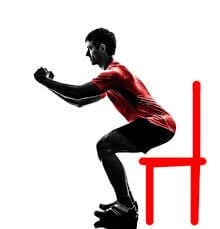
Getting up out of a chair is something that is very often done wrong and here are some great tips to improve how you do it.
Lean forward at the hips
Look up
Nose over toes
Drive up!
This technique utilizes your body weight going froward.
You need to lean forward so that you nose goes over past your toes.
This will start you falling forward, and then all you need to do is push up with your legs to stand up-right.
Remember if you are looking down, you might go down, so keep you chest up-right and focus on the top of the wall.
In the following section you will see how this can be utilized as one of a great exercises to help get off the floor by strengthening your muscles.
2. How to Get up Off the Floor
The main thing here is to:
Roll onto your side and plant your hands on the floor
Push your upper body up, so that your arms and straight
Pivot onto your knees so that your hip comes off the ground – This will get you into four-point kneeling
From there you need to bring one foot forward and plant it – from there you can drive up with that leg.
Watch the video here for a good demo of how to get both down safely and up again:
Now that we know the right techniques of getting off of the floor or a chair.
Let us talk long term and discuss exercises you can incorporate in your daily routine to strengthen the muscles that help you get off of the floor or chair easier.
Strengthening Exercises
Strengthening exercises, when done regularly can make so many daily activities a lot easier. And I don’t mean going to the gym and throwing iron around.
These are some great exercises that you can do at home that will help you get up off the floor or chair easier.
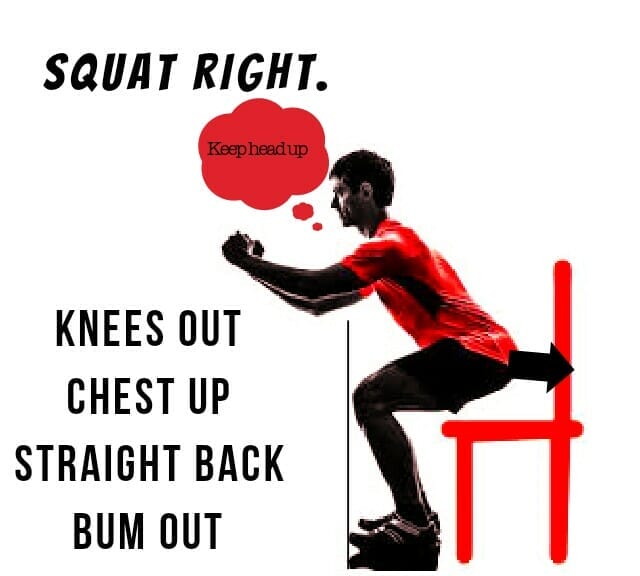
1. Sit-To-Stand / Squat
Great functional exercise. If you are finding it difficult to stand up out of a seat, then one of the best ways to improve is practice.
Build up the muscle memory using the correct technique.
Sitting down into a chair and standing up again is almost like doing a good squat.
You can use the same technique to do it right.
Now, I know that not everyone can start doing this straight away, so I have included two levels:
Level 1 (Beginner): Modified Sit-To-Stand
Add a pillow or a cushion to the chair: Here, we make it easier by adding a pillow or cushion to the chair. This raises up the platform and means less distance for you to go up, making it easier on your legs.
Now, I want you to use the correct sit-to-stand technique I taught you above, to do this exercise.
Stand up from the chair, not using your arms (your legs are only going to get stronger by working at it).
Slowly sit back down again using the same technique as when you came up (except in reverse!)
This is a great one for strengthening your posterior chain and is very functional.
Remember to make it easier just place cushions, or solid books etc on the chair seat to raise the platform.
Do 3 sets of 10 – that means do ten sit-to-stands, have 1 minute break and repeat 2 more times.
Level 2 (Advanced): Full Sit-To-Stand
For the advanced level hold a small weight in your hands in front of you, start with 1-3kg.
This the same as Level 1 but without the cushion or pillow to raise it up.
You are doing it right onto the chair seat but adding weights to give those muscles more resistance to push through.
This will make them stronger in a long run.
2. Bridges
Your extensors (Glutes, back muscles, hamstrings etc) are what really drive you upwards and straighten you up at the hip and torso.
This is a great exercise to do to get them working for YOU and the good thing is that it can be done on a firm bed or bench, as well as the ground.
Bridge increases leg strength, glute activation and decreases back pain.
How to do it:
Lying on your back, on the ground, firm bed or bench, bend your knees up and place your feet on the ground.
Pushing through your heels and keeping your back straight, lift your bottom off the ground
Lower down again, in control the entire time
Repeat 10 times for 3 sets.
Tip: If you get back pain doing this or hamstring spasm, try moving your feet in closer to your bottom – this will likely make it easier.
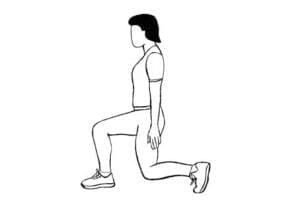
3. Lunges
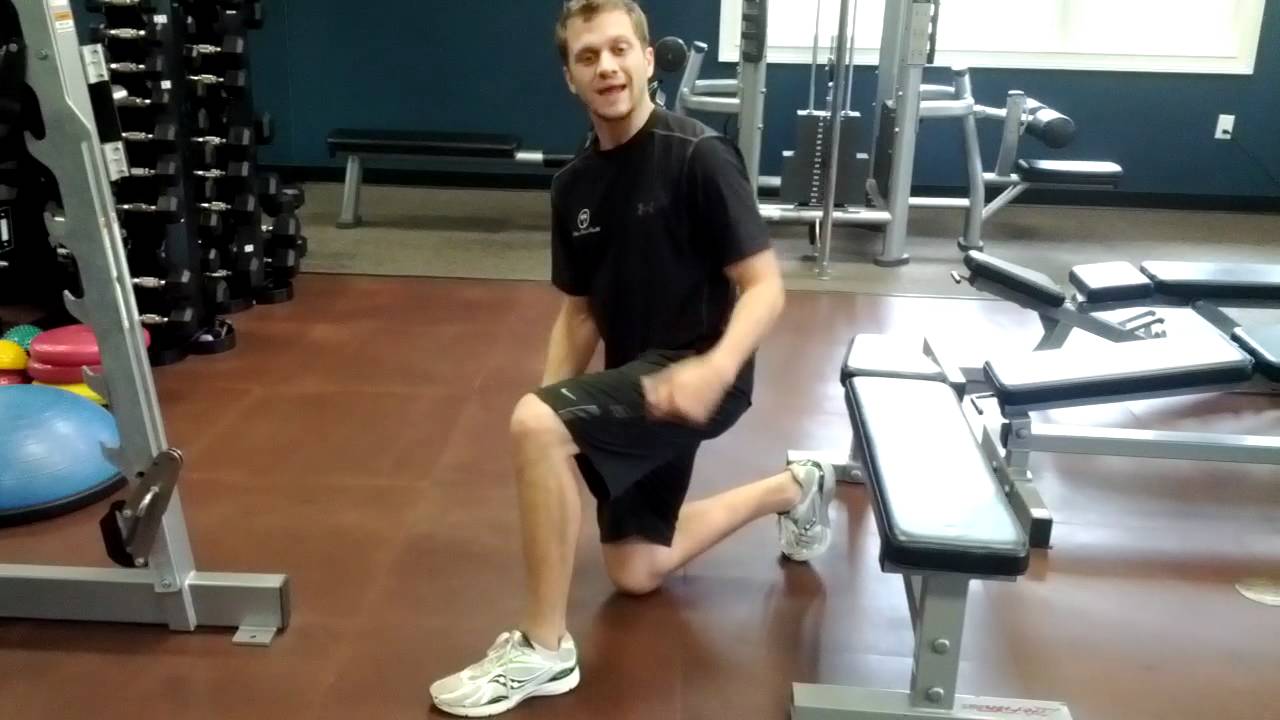
This exercise builds great control and strength through your hips.
How to do it:
From a standing start, take a step forward, planting your front foot
As shown in the picture, bend the back knee towards the ground, keeping your toes on the ground.
Control this all the way with your front leg – this will be doing a lot of the work
Only go down as far as you can comfortably and safely
Push off with your front leg so that you come back to standing
Repeat 5 times on each side for 3 sets.
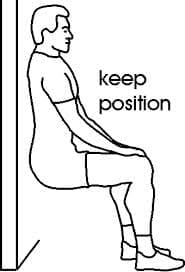
4. Wall Squats / Wall Sits
These exercises are great for targeting your quads (thighs), these, along with your extensors help drive you upwards, straightening out your knees.
These are easier than the name lends to thinking but as earlier, there are two levels.
This helps for you start where you feel comfortable and don’t feel like being thrown straight in the deep end
Level 1 (Beginner): Squat and Hold
How to do it:
Lean against a wall with your feet at least a foot out from the wall
Slide your back down the wall, controlling this with your legs until you are about halfway down
Only go down as far as you are comfortable with!
Hold this for 5 seconds and then slide back up again
Repeat 10 times
Level 2 (Advanced): Swiss Ball Wall Squats
You will need a swiss ball (also called gym balls among other things) for this good little exercise
How to do it:
Place the ball against the wall and lean against it at the height of your low-back – make sure your feet are out from the wall
Slowly squat down, keeping the pressure against the ball
Only go down as far as is comfortable.
Return back up and repeat 10 times for 3 sets
5. Single Leg Standing
This exercise helps increase your balance and hip control which would help getting off of the floor easily.
Level 1 (Beginner):
How to do it:
Stand on one leg on the floor
Don’t let your legs touch each other
Goal: hold for 1 minute
Tip: if you cannot hold this very well, you can start with one finger on a wall or bench close to you
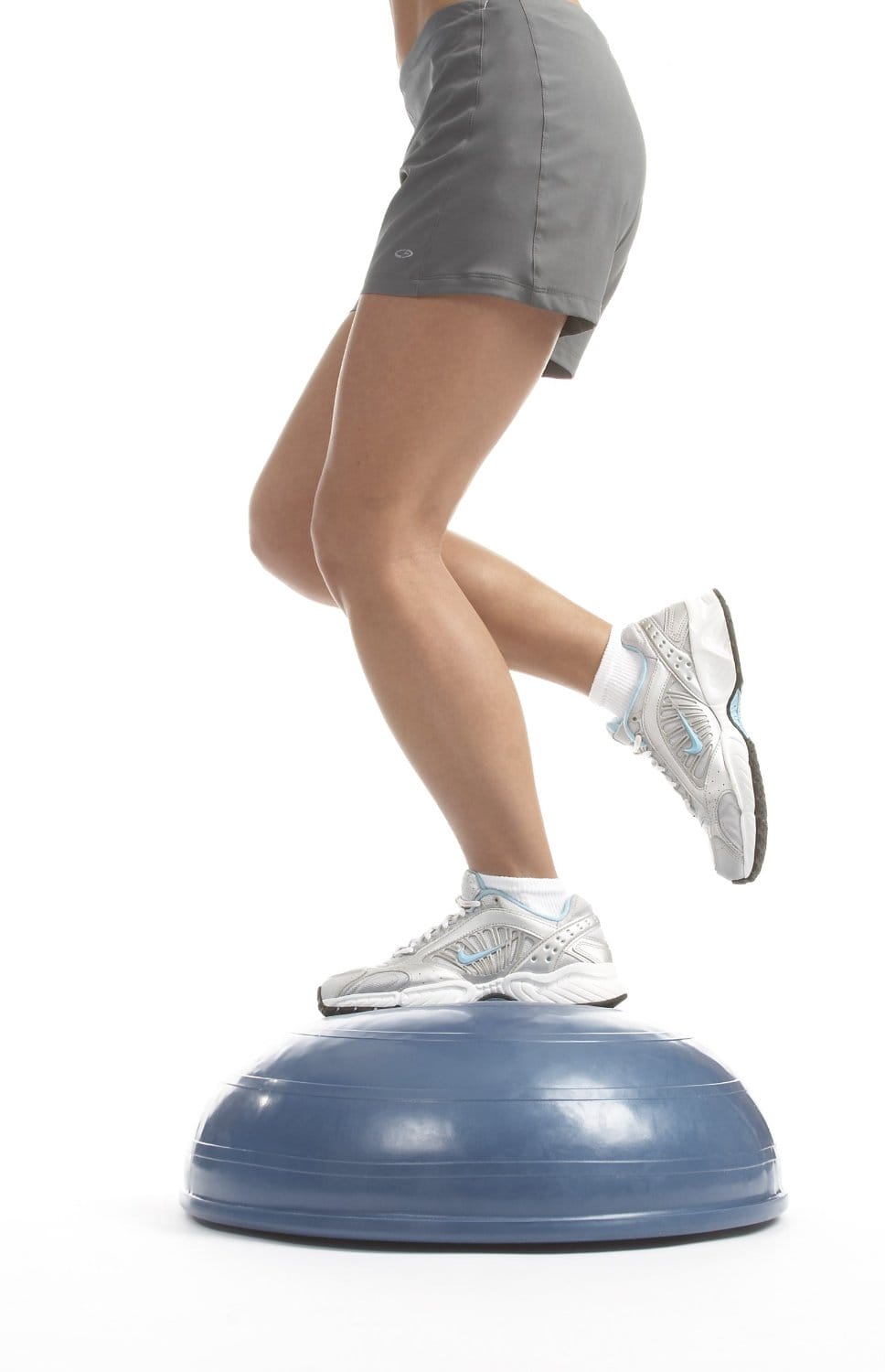
Level 2 (Advanced):
How to do it:
Stand on a wobble board, dura disc or bosu ball on one leg
Aim to hold this for 1 minute or build up to it
If you cannot afford one of these you can also fold up a towel and stand on that – rolling it up firm to make it harder
Feed Your Muscles: Nutrition That Supports Strength and Recovery
Exercise is only part of the picture.
What you eat plays a huge role in whether your muscles respond to those exercises, how quickly they recover, and how well your joints and connective tissue hold up over time.
Here are the key nutritional pieces that directly support the kind of strength and mobility we’re talking about in this post.
Protein — The Most Important One
If there’s one thing to take away from this section, it’s this: most people over 50 are significantly under-eating protein.
Protein is the raw material your body uses to build and maintain muscle tissue. Without enough of it, the exercises above will produce far less improvement than they should.
A practical target for most adults is roughly 1.2–1.6g of protein per kilogram of body weight per day.
So for a 70kg person, that’s around 85–110g of protein daily.
Good sources include eggs, chicken, fish, Greek yoghurt, legumes (lentils, chickpeas), tofu, and cottage cheese.
Spreading protein intake across meals — rather than having most of it at dinner — also helps your body use it more effectively.
Vitamin D and Calcium — Not Just for Bones
Vitamin D deficiency is surprisingly common, even in sunny climates, and it has a direct impact on muscle function — not just bone strength.
Low Vitamin D levels are linked to muscle weakness, poor balance, and a higher risk of falls in older adults.
The best source is sensible sun exposure, but many people — especially those who are less mobile or spend a lot of time indoors — benefit from a supplement.
Calcium works hand in hand with Vitamin D, and leafy greens, dairy, almonds, and sardines are all excellent dietary sources.
Magnesium — The Overlooked One
Magnesium is involved in over 300 biochemical reactions in the body, including muscle contraction and relaxation.
Low magnesium can contribute to muscle cramps, stiffness, and poor recovery after exercise.
Dark leafy greens, nuts, seeds, dark chocolate, and legumes are all good sources.
If you regularly experience muscle cramps or find your muscles feel tight even when you’re not exercising much, low magnesium is worth looking into with your GP.
Omega-3 Fatty Acids — Fighting Inflammation
Chronic low-grade inflammation is one of the less-discussed drivers of muscle and joint decline as we age.
Omega-3 fatty acids — found in oily fish like salmon, mackerel and sardines, as well as flaxseed and walnuts — have well-documented anti-inflammatory effects.
They also support joint lubrication, which matters a lot when you’re working on hip and knee mobility.
Aim for oily fish two or three times a week, or consider a quality fish oil supplement if that’s not realistic for your diet.
You don’t need to overhaul your entire diet overnight.
Small, consistent improvements in these areas will compound over time and make a noticeable difference to how your body responds to the exercises above.
Daily Habits That Make a Bigger Difference Than You Think
The exercises in this post are powerful — but they’re most effective when they sit inside a broader lifestyle that keeps your body moving and your muscles active throughout the day.
Here are some simple habits that directly support your ability to get up and down with confidence.
Get Down to the Floor — On Purpose
This sounds almost too simple, but it’s one of the most effective things you can do.
Make it a daily habit to get down onto the floor and back up again, even if it’s just to stretch or sit while watching TV.
The act itself is the training. Cultures where people regularly sit on the floor — Japan and many parts of Asia — consistently show better lower body mobility and strength into older age.
You don’t have to meditate or do yoga (though you can!) — just getting down there regularly keeps the movement pattern sharp.
Take the Stairs — Every Time
Stair climbing is one of the best functional exercises you can do for the exact muscles we’ve been talking about: quads, glutes, and calves.
It also has a meaningful cardiovascular benefit.
It doesn’t need to be a workout — just make the choice to use stairs whenever they’re available.
Over the course of a week, those small decisions add up significantly.
Consider Yoga or Tai Chi
Both of these practices specifically target the combination of strength, flexibility, balance, and body awareness that underpins the ability to get up and down safely.
You don’t need to be flexible to start — that’s what the practice develops.
Even a gentle beginner yoga class or a YouTube yoga routine twice a week can produce noticeable improvements in hip mobility and stability within a few weeks. (Yoga for back pain)
Tai Chi has particularly strong evidence for fall prevention in older adults and is very low impact on the joints.
Move Every Hour
If you spend a lot of time sitting — at a desk, in front of a screen, or watching TV — set a reminder to get up and move for at least two to three minutes every hour.
It doesn’t need to be exercise — walk to the kitchen, do a few standing stretches, go up and down the stairs once.
Extended sitting progressively tightens your hip flexors and switches off your glutes, which is exactly the pattern that makes getting up harder.
Breaking up sitting time is one of the highest-leverage habits for long-term mobility.
When Should You See a Doctor or Physiotherapist?
For most people, difficulty getting up from the floor or a chair is primarily a strength and mobility issue — and the exercises and habits above will make a real difference over time.
However, there are some situations where it’s worth getting a professional opinion before you dive into the exercises, or if things aren’t improving as expected.
It’s worth seeing your GP or a physiotherapist if:
You experience significant pain in your hips, knees, or back when attempting to get up — not just effort or mild discomfort, but sharp or severe pain.
You’ve had a recent fall or a near-fall — this warrants a proper balance and strength assessment.
One leg feels noticeably weaker than the other, or you have numbness, tingling, or weakness that has come on recently.
You have a known joint condition such as osteoarthritis, osteoporosis, or a previous hip or knee replacement — you may need modified versions of some exercises.
You’ve been doing the exercises consistently for four to six weeks with no improvement — there may be an underlying factor that needs to be identified.
These exercises are safe for the vast majority of people, but your body is unique.
If something doesn’t feel right, trust that instinct and get it checked out.
A good physiotherapist can assess your specific movement patterns and give you a tailored program that builds on what’s in this post.
Conclusion:
It isn’t until we can’t do simple tasks like getting off of the floor or a chair, that we really appreciate how important they are.
Follow the techniques mentioned above and start strengthening your muscles to see amazing results.
As I mentioned above, these exercises are effective if they are done regularly, so make it routine and stick to it.
Aim to do these exercises at least 4 times per week and you will really notice the difference.